dMaya — independent AI product
An agent that designs the whole product.
dMaya turns a brief into a connected, responsive interface—and carries the work into code or Figma.
- Built by Ekyon
- Product strategy, experience design and AI engineering
- The product
- Agent workspace, live canvas and Figma handoff
- For
- Founders, designers and product teams
dMaya / product canvas
Live product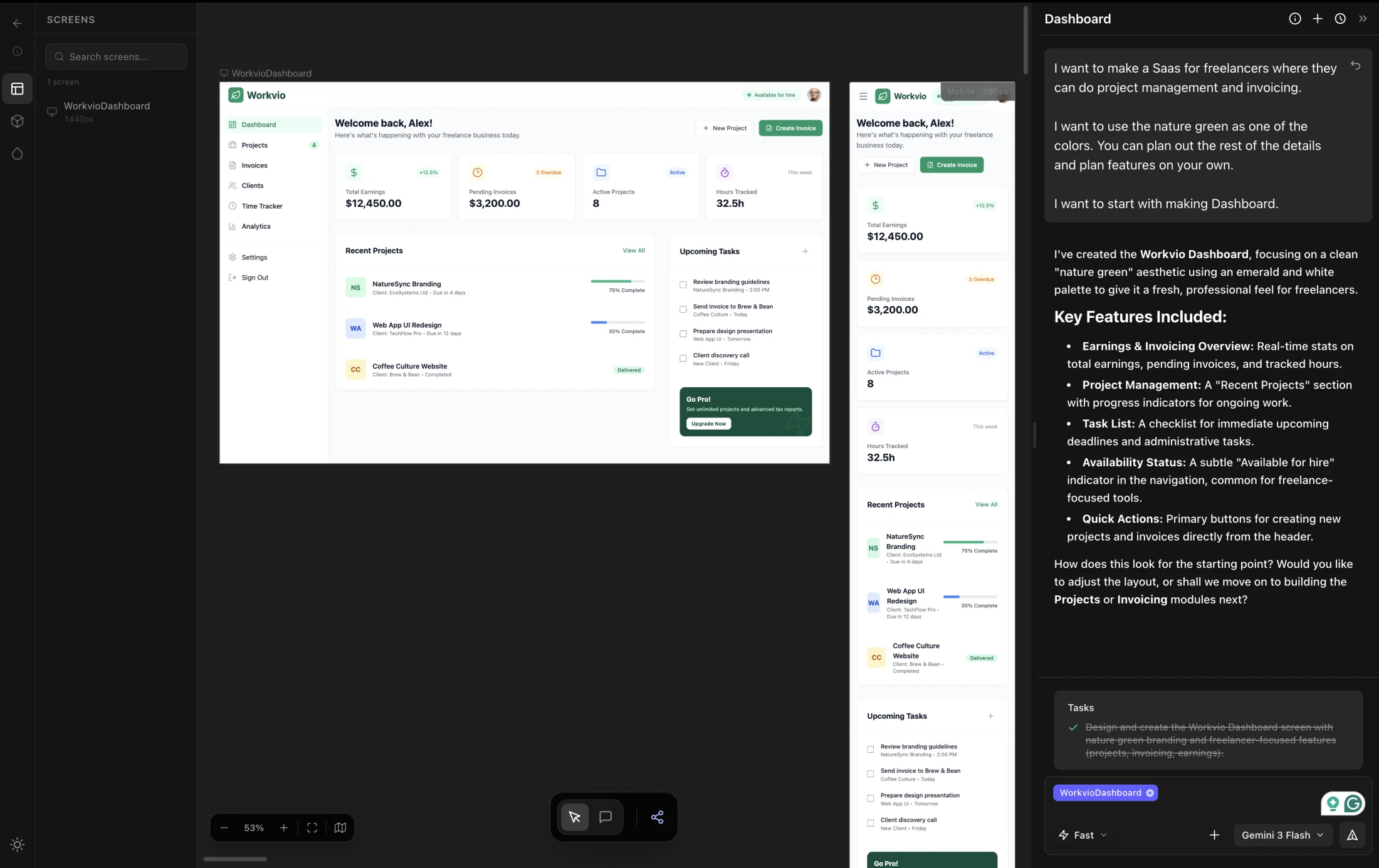
One workspace, the whole product-design loop.
- Multi-screen canvas
- Responsive previews
- Agent chat & tool activity
- Shareable output
AI can draw a screen. A product needs much more.
Most AI design workflows are optimized for the first impressive image. Real products are judged on everything after that: whether the second screen matches the first, whether mobile works, whether a stakeholder can review it, and whether an engineer can actually use the result.
We built dMaya around continuity. It treats a product as a living system of screens, components, tokens, decisions, and conversations—not a disposable prompt result.
02 / The experience
From loose idea to review-ready interface.
The complexity stays behind the canvas. The user gets a clear, conversational workflow.
- 01
Describe the product
Start with an outcome, audience, constraints, or even a rough idea. dMaya can ask for missing context before it starts.
- 02
Let the agent plan
The agent researches patterns, maps the experience, breaks complex work into tasks, and chooses the right tools for the job.
- 03
Watch screens appear
Responsive, working HTML streams onto an infinite canvas as it is created—across multiple screens and device sizes.
- 04
Refine and hand off
Select a screen or component, steer the next change, compare versions, share a live preview, and export production-ready output.
03 / What users get
Serious product capability, without a technical learning curve.
From brief to system
Multi-screen product thinking
dMaya does not stop at a pretty hero section. It can map dashboards, flows, states, mobile variants, and the supporting screens that make an interface usable.
One language everywhere
Built-in design systems
Reusable components, theme configurations, and design tokens help every new screen inherit the same visual rules instead of drifting with each prompt.
Design by conversation
Precise iterative editing
Users can target a screen or component, request a focused change, interrupt a run, answer a clarification, and keep the rest of the project intact.
Review without friction
Live previews and comments
Shareable previews update in real time, so founders, clients, and teammates can review the actual interface—not decipher a static deck.
04 / Inside the agent
One request. A controlled design run.
The interface stays simple because the harness coordinates the context, planning, tools and safeguards behind it.
How a dMaya run works
Observable from prompt to preview“Add reporting to this product. Reuse what is already here and make it work on mobile.”
- 01Context
Read the product
Screens, components, tokens and prior decisions.
- 02Reason
Plan the change
Break down the work and choose the right model.
- 03Act
Use design tools
Create, edit and reuse real product artifacts.
- 04Verify
Stream safely
Preview, approve, snapshot and keep every change reversible.
One source of truth follows the entire run.
- Screens
- Components
- Tokens
- Memory
- Versions
- 32
- purpose-built tools
- Realtime
- streaming execution
- Versioned
- approval and change history
- Persistent
- context across long projects
05 / Proof in motion
One brief. A connected family of screens.
This real dMaya session shows the canvas holding a complete product direction while the agent reasons about features and continues the build.
06 / Beyond the canvas
The output has somewhere useful to go.
dMaya produces working HTML, CSS, and Tailwind—not a flattened picture. For design teams, we also engineered an HTML-to-Figma conversion pipeline and a Figma Community plugin that rebuilds supported UI as editable layers, text, vectors, fills, borders, and shadows.
<section class="product">
  <h2>Built to edit</h2>
  <button>Continue</button>
</section>07 / What this project proves
We can build the interface, and the intelligence behind it.
dMaya is the kind of product we most enjoy building: technically ambitious, deeply visual, and only valuable when every layer works together.
It brought product strategy, interaction design, agent architecture, realtime infrastructure, persistent state, billing, collaboration, conversion engines, and go-to-market into one system owned end to end by our team.
See the product for yourself