EKYON CASE STUDY / HOTEL BIDDING PLATFORM
BidMyRoom.
A hotel bidding
platform, designed
and built.
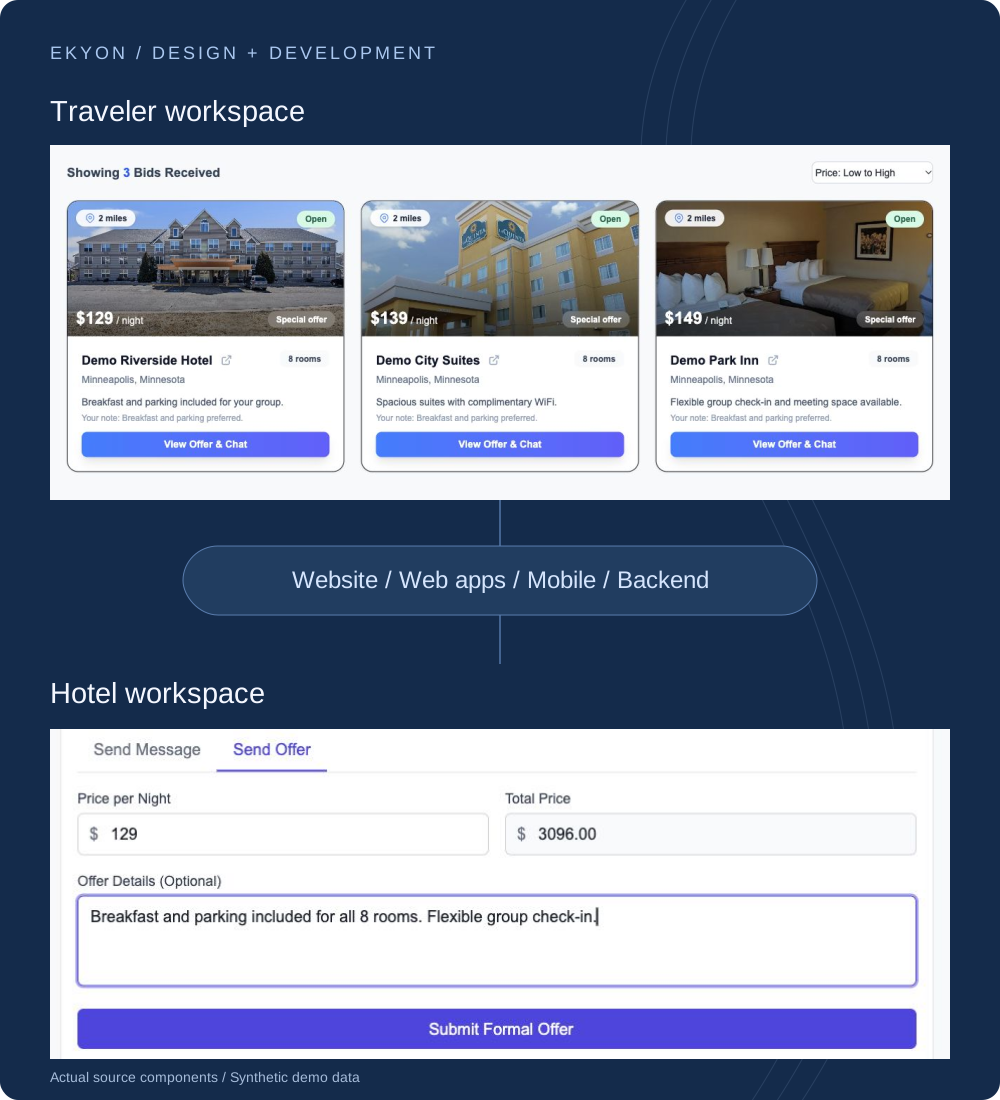
An organizer shares the stay they need. Hotels respond with offers tailored to its dates, room count, and budget.
Our delivery Product design, a public website, traveler and hotel applications, administration, and shared backend integrations.
- SERVICES PROVIDED
- Product design & full-stack development
- DELIVERY SCOPE
- Website, web apps, mobile apps & backend
- DEVELOPMENT PERIOD
- 2025–2026
01 / WHAT EKYON PROVIDED
What we delivered
for BidMyRoom.
We designed and developed the experiences for travelers and hotels, then built the applications and services that support them. The project included six distinct parts of the product.
Website development
Public website
Travel use-case pages, hotel discovery, and an entry into the stay-request journey.
Product design + development
Traveler web application
Stay requests, competing offers, conversations, account views, and provider booking pages.
Product design + development
Hotel web application
Property onboarding, lead management, bidding, staff access, and subscription screens.
Mobile development
Two mobile applications
Separate traveler and hotel applications built with React Native and Expo.
Web development
Administration application
Tools to manage users, hotels, hotel staff, requests, broadcasts, and access.
Backend + API development
Backend & integrations
Shared business services, messaging, reservations, subscriptions, and notifications.
The sections below show the delivered interfaces and implementation scope. Mobile and administration are documented from source.
02 / UNDERSTANDING THE PRODUCT
A stay request becomes
the starting point.
BidMyRoom brings a request-led approach to hotel booking. A wedding organizer, team coordinator, or company arranging a crew stay can share requirements once and receive hotel proposals. Hotels can respond to that specific demand with a tailored rate and a conversation.
THE CLIENT’S PRODUCT MODEL
- 01
Describe the stay
Destination, dates, rooms, budget, and requirements.
- 02
Receive hotel proposals
Hotels review the request and make an offer.
- 03
Compare and discuss
The organizer evaluates offers and talks with hotels.
HOW WE TRANSLATED THAT INTO SOFTWARE
Structured request forms capture the details hotels need. Separate workspaces support the organizer and the hotel team. Shared services connect every offer and conversation back to the stay.
Request types and the two booking paths
The implementation supports individual, group, and corporate requests. Group requests carry a group name and type; corporate requests can include company and project details. Direct hotel bidding and Expedia inventory checkout are separate paths. Accepting a hotel offer does not automatically create an Expedia reservation.
03 / DELIVERY / WEBSITE & TRAVELER APPLICATION
The public presence.
The customer product.
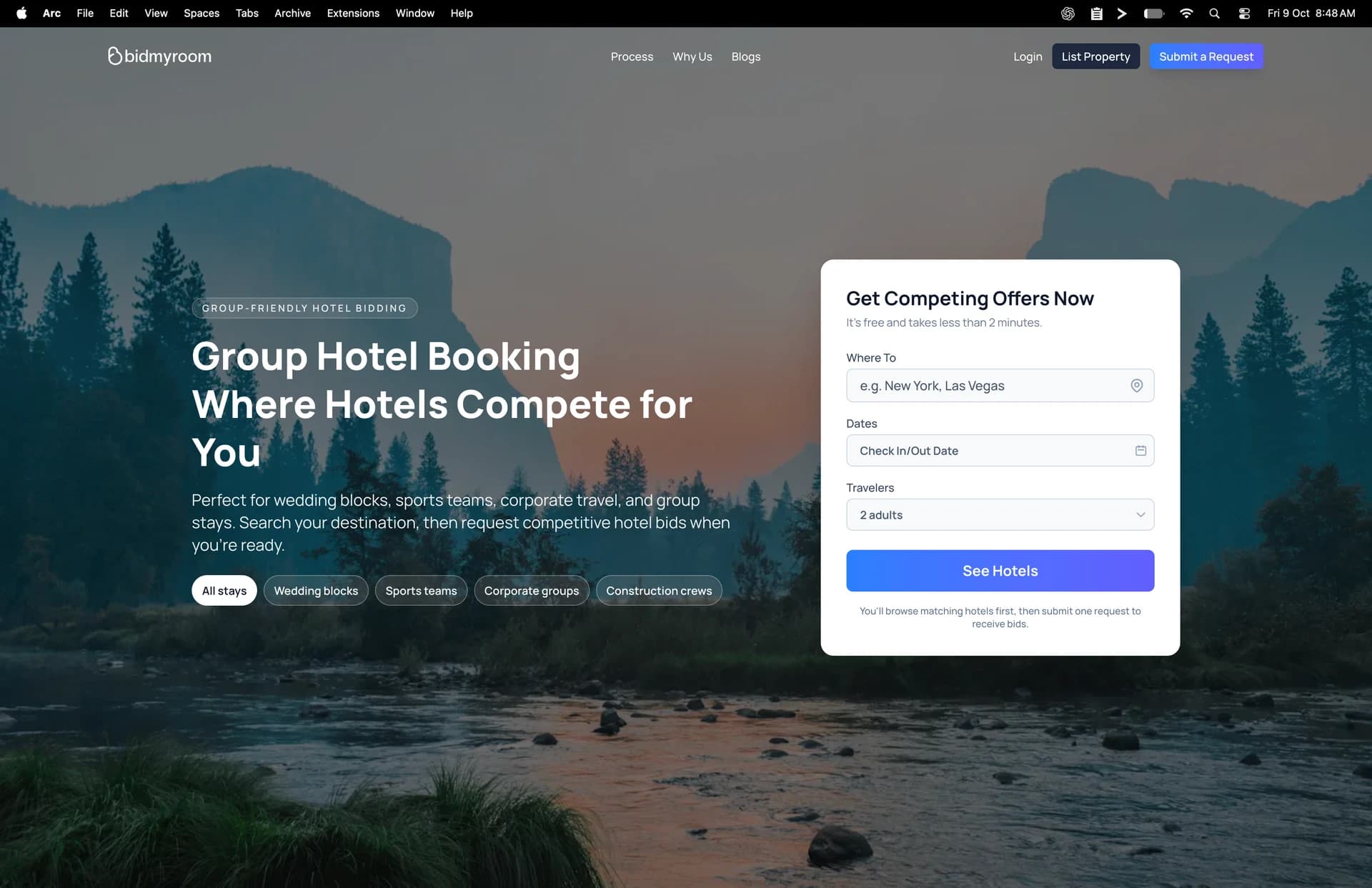
We provided the public website and the traveler web application behind it. The scope connects use-case pages and hotel discovery with request creation, offer comparison, conversations, and a separate provider booking journey.
PUBLIC WEBSITE
A starting point for
different kinds of stays.
- Use-case pages
- Group booking, weddings, sports teams, corporate travel, crew housing, and events.
- Discovery & product entry
- Destination, date, and traveler inputs, hotel listings, property pages, and request creation.
BidMyRoom / Public website
TRAVELER WEB APPLICATION
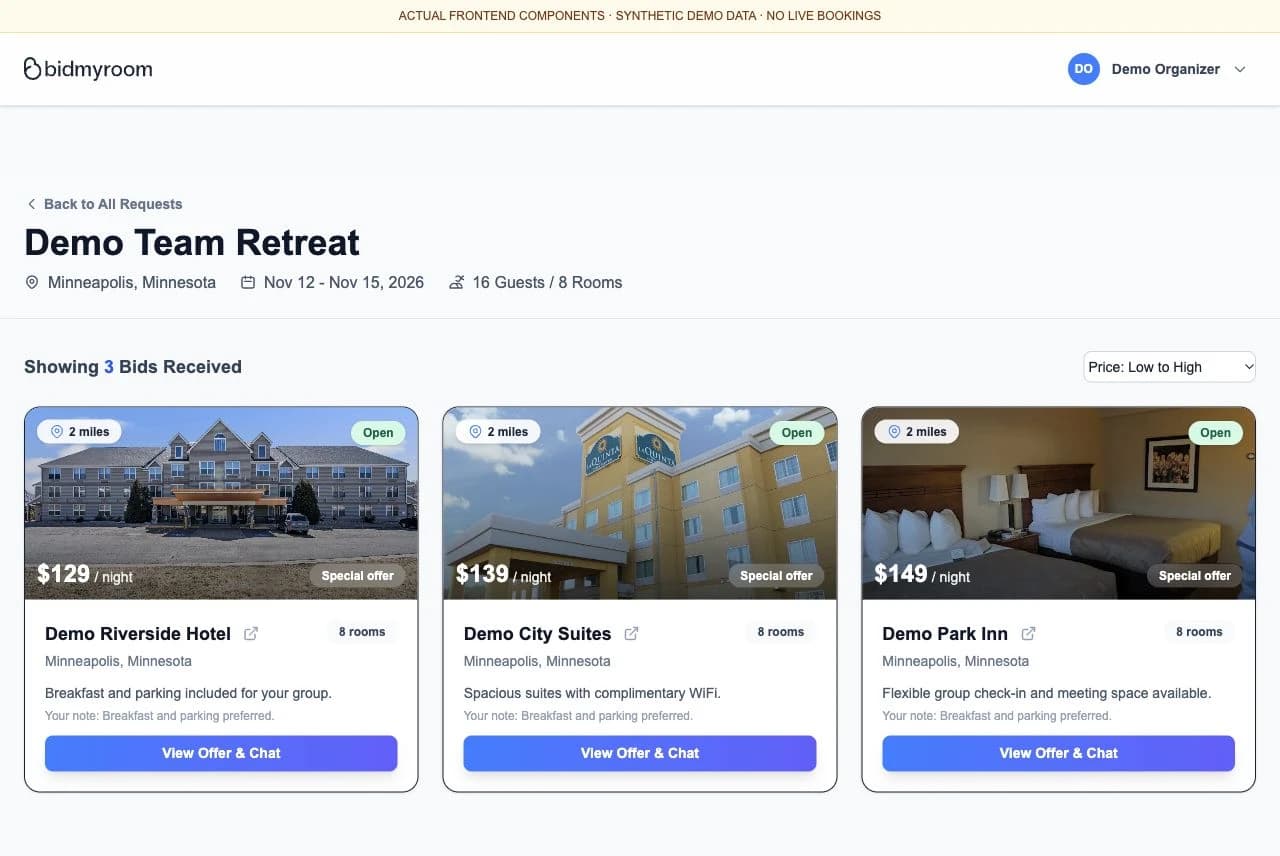
From a request to an informed decision.
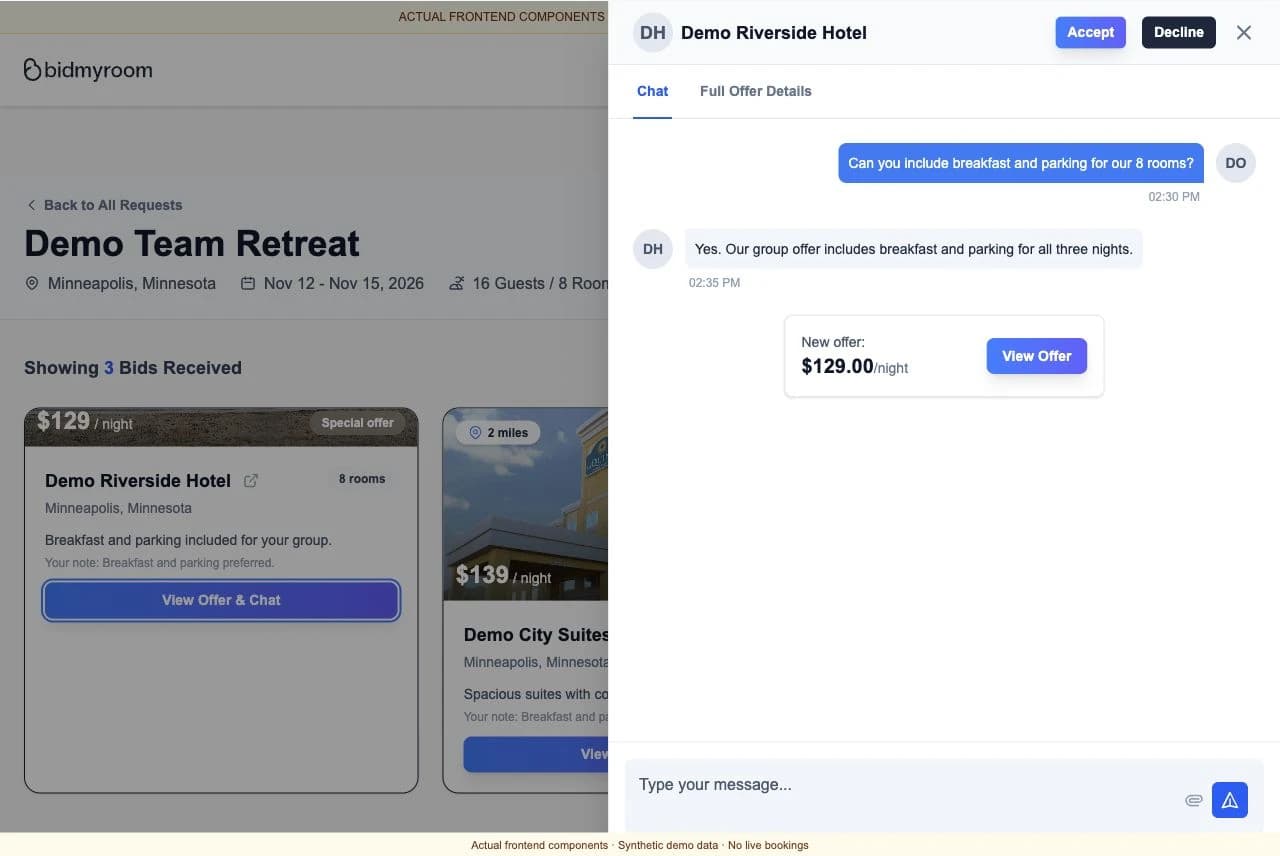
We designed the offer view to keep the nightly rate, property context, and stay requirements together, with the conversation close to the proposal.
BidMyRoom / Source frontend components
- Request & offer interfaces
- Forms for different stay types, account and request views, hotel offers, and conversation panels.
- Provider booking interfaces
- Room selection, guest details, price breakdowns, payment, review, and confirmation pages.
Traveler application implementation
The traveler application uses Next.js and React. Shared request data populates its offer cards and conversations. Provider booking screens account for room occupancy, inclusive and exclusive pricing, and charges due at the property. A frontend integration guide documents the occupancy and fee-display implementation. Screenshots use synthetic API fixtures and do not demonstrate completed reservations.
04 / DELIVERY / HOTEL WEB APPLICATION
A working environment
for the hotel team.
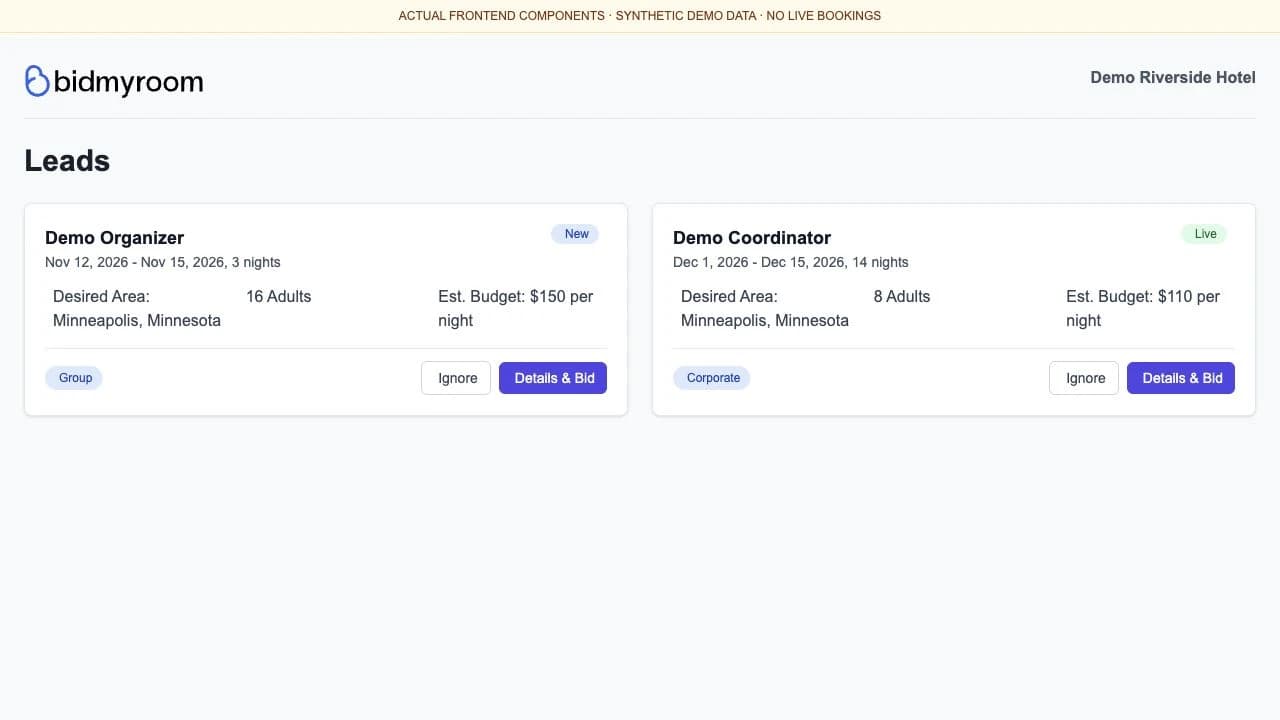
We provided a separate hotel application for receiving demand and responding to it. Its scope includes property setup, a lead workspace, offer creation, conversations, staff permissions, and subscription management.
BidMyRoom / Source frontend components
- Property onboarding & profile
- Hotel selection and setup, details, photos, amenities, and policies.
- Lead & bidding workspace
- Stay requirements, lead actions, offer forms, and hotel conversations.
- Team access
- Staff accounts, roles, and permission controls for hotel-side work.
- Account & subscriptions
- Profile and password settings, subscription views, and billing integration.
Connecting the hotel interface to business rules
A hotel lead links the property and staff account to a stay request. The offer form calculates the quoted total using nightly rate, room count, and duration, and sends a typed offer into the related conversation. Staff messages retain the account identity while belonging to the hotel's shared conversation.
05 / DELIVERY / MOBILE & ADMINISTRATION
Mobile access for both sides.
Tools for the operator.
The delivery included two mobile application codebases and a dedicated administration web application. Travelers and hotel teams have their own mobile experiences; the business has a separate place to oversee accounts, properties, and requests.
Traveler app
Stay requests, hotel browsing, offers, conversations, account screens, and provider booking screens.
React Native / ExpoHotel app
Property onboarding, leads, bidding conversations, hotel details, staff access, and subscriptions.
React Native / ExpoAdministration
User, hotel, and hotel-staff management, request details, broadcasts, and access controls.
Next.js / ReactConnected through shared backend services
Accounts · Requests · Leads · ConversationsMobile and admin scope verified in the source code. The visuals here document application scope; they are not device or admin screenshots.
Application boundaries
The project contains separate traveler, hotel, and administration Next.js applications, plus separate traveler and hotel React Native / Expo applications. Shared backend services provide the business records and integrations. Mobile apps were inspected without launching iOS or Android simulators. This case study makes no claim about current app-store availability.
06 / DELIVERY / BACKEND ENGINEERING
The rules and services
behind the interfaces.
We implemented the backend that turns a stay request into hotel leads, connects offers to conversations, and updates related records when a decision is made. Messaging and notifications connect that work across the applications.
- Request & lead services
- Structured stay records, nearby-hotel lead creation, request status, and expiry rules.
- Offer & conversation services
- Typed offers, message delivery, acceptance and decline actions, and defined conversation windows.
BidMyRoom / Source frontend components
ONE EXAMPLE OF THE ENGINEERING SCOPE
An accepted offer updates
the related work.
- The request, chosen lead, and conversation become accepted.
- Competing bid leads are declined and their conversations close.
- New unbid leads are removed; hotel staff receive updates.
Acceptance and follow-up rules
The acceptance service saves accepted states for the request and selected conversation, declines competing bid leads, marks the selected lead accepted, removes new unbid leads, and closes other conversations. The chosen conversation has a seven-day follow-up window. This describes implementation found in source, not a backend transition exercised during capture.
07 / DELIVERY / EXTERNAL INTEGRATIONS
Booking, billing, and updates.
Connected to the product.
Our integration work covered the services around the core bidding experience: provider reservations, hotel subscriptions, live messages, email and mobile notifications, and property media storage.
- ReservationsExpedia Rapid
- Property discovery, availability, price checks, booking records, recovery, and cancellation handling.
- Hotel billingStripe
- Hotel subscription creation and changes, billing portal access, and subscription status synchronization.
- Messages & notificationsSockets, email & Expo Push
- Message updates and notifications for requests, offers, hotel staff, and booking events.
- Property mediaAWS S3
- Upload and storage services for hotel photos and other media.
The implementation around a provider reservation
The Expedia path includes current-price checking before booking, itinerary and confirmation records, payment-session handling, recovery, and cancellation endpoints. Webhooks and itinerary refresh update later booking states. Hotel subscription billing uses Stripe separately. Integration scope was verified in source; no live payments or production bookings were exercised.
08 / THE PROJECT AS A WHOLE
Design and development
across the full product.
BidMyRoom shows the scope we can take on when a product needs more than a public website: distinct user applications, operational tools, custom business logic, and external services that work around the same product model.
DELIVERED IMPLEMENTATION
- Public website and traveler web application
- Hotel and administration web applications
- Traveler and hotel mobile codebases
- Shared backend and external integrations
- Frontend integration documentation
Technology and implementation documentation
Web: Next.js, React, and TypeScript. Mobile: React Native and Expo. Shared services: Express, TypeScript, and MongoDB. The traveler repository includes a frontend integration guide for guest occupancy, price breakdowns, taxes and fees, and charges due at the property.
YOUR PROJECT WITH EKYON
What does your product
need us to deliver?
We can help define the design, applications, and integrations your business needs.